Stove and Cooktop Repair
Gas burners that click without lighting, electric coils and glass radiant elements that will not heat.
DetailsAn oven that will not reach temperature almost always has one failed part: a bake element, an igniter, a temperature sensor or a relay on the control. We find which one with a meter before anything gets replaced.
Updated October 2026
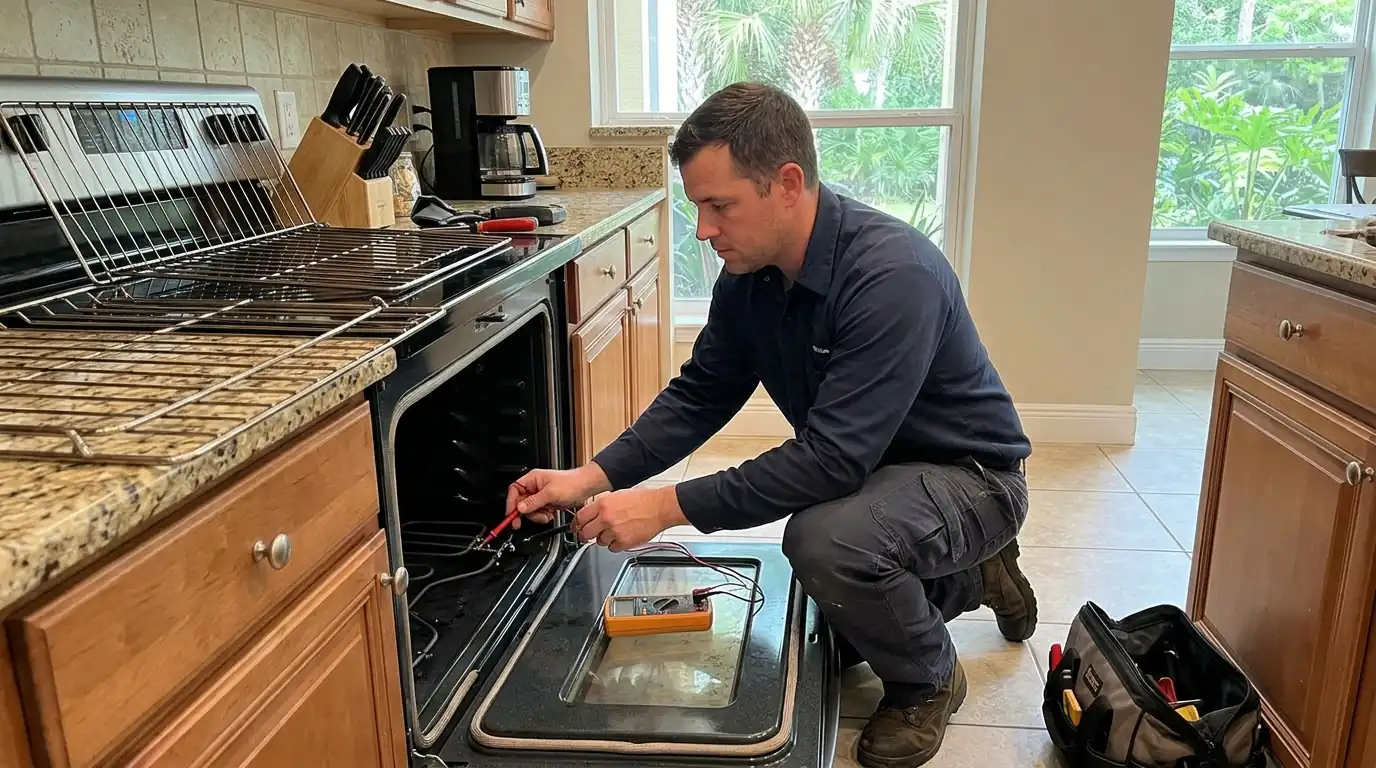
Oven repair in Jacksonville usually means a burned-out bake or broil element, a weak gas igniter, a failed temperature sensor, a self-clean door lock or a control board relay. We test the circuit, quote the part and labor, and confirm the oven holds temperature before leaving.
Electric ovens heat with a bake element on the floor and a broil element at the top, controlled by a sensor and relays on the board. A bake element that splits or blisters stops heating from below, and the oven bakes slowly or only browns the top. A sensor that reads wrong makes the oven run hot or cold against the dial.
Gas ovens use a hot-surface igniter that has to draw enough current to open the safety valve. Igniters weaken with age, so the oven takes longer and longer to light until it stops lighting at all, while the cooktop burners still work fine. That pattern is one of the most common oven calls we take.
Cost
Most oven repairs are an element, an igniter, a sensor, a lock or a control relay. The range below is national cost data for oven repairs. Wall ovens add labor because the unit has to come out of the cabinet.
Planning range from published cost data (homeadvisor.com), not a quote and not our price. Your number depends on the diagnosis and the part.
DIY or call
| Task | Safe to try yourself | Call a technician |
|---|---|---|
| Clock or delay start set | Clear any delay timer or Sabbath mode | If it still will not heat |
| Breaker | Check both halves of the oven breaker | If power is on and no heat |
| Temperature off | Check with an oven thermometer | If it is more than about 25 degrees off |
The jobs this page covers
On an electric oven we check the bake and broil elements for continuity and visible damage, the sensor against its resistance chart and the relays on the control that send power to each element. On a gas oven we watch the igniter: a glow that never lights the burner means a weak igniter that is not drawing enough current, and no glow at all means power is not reaching it. We also check the oven's thermal fuse, which some models use to cut heat when they overheat. Each of those has a clear test, so there is no guesswork about the part.
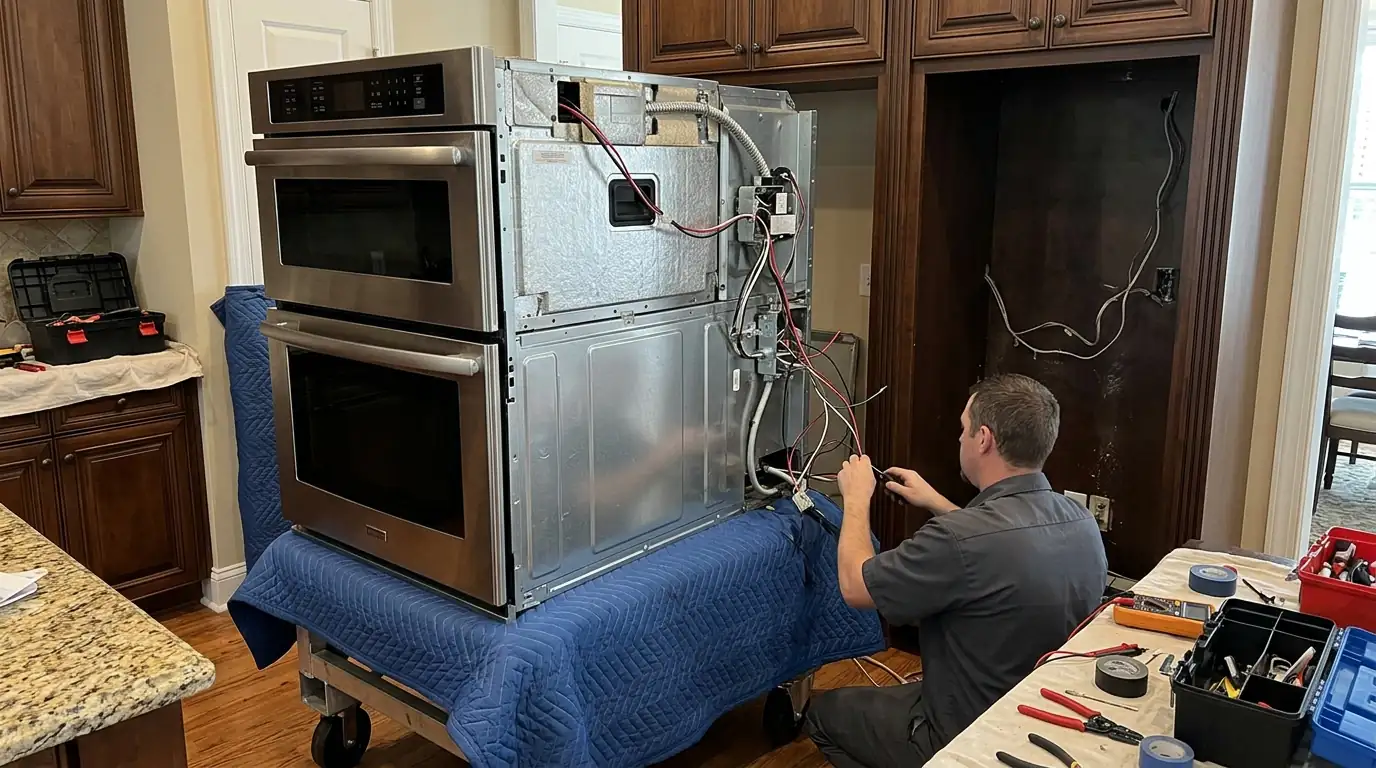
Wall ovens are electric in most homes and often stacked as double ovens or paired with a microwave above. To reach the elements, wiring and fan, the oven usually has to slide forward out of the cabinet onto a protected counter or support. We do that with care for the trim and the cabinet face, test and repair the failed part, and reseat the oven square in its cutout. Double ovens can fail on one cavity only, and we test each cavity separately.
Self-clean runs the oven far hotter than baking, and it is the cycle most likely to finish off a tired part. A door that stays locked after self-clean, a lock motor that buzzes, or a control that throws a lock code after cleaning all point at the lock assembly or its switches. Elements and fuses also tend to fail during self-clean. We free the door safely, repair the lock or the part that failed, and explain how to use self-clean with less stress on the oven.
A convection oven adds a fan and often a third element at the back wall. A fan that grinds, squeals or will not spin, or a convection mode that bakes unevenly while regular bake is fine, points at the fan motor or the convection element. On many ovens the fan is reached from inside the cavity after removing the back cover, so it can be a short repair. We test the convection element and the fan relay on the control at the same time.
Arlington is known for its mid-century modern houses, including homes designed by Robert C. Broward, Taylor Hardwick and William Morgan, and many original kitchens there were built around wall ovens set into custom cabinetry. Replacement ovens do not always match those old cutouts, so repairing the oven you have is often worth more than usual. When we pull one forward, we protect the original cabinet faces.
Step by step
We watch how the oven heats and read the actual temperature.
Element, igniter, sensor, fuse and relays.
Price first, then the part goes in.
A bake test to temperature before we leave.
Ovens we repair most: GE, Whirlpool, Frigidaire, Samsung, LG, KitchenAid, Bosch and Thermador.
FAQ
The bake element on the floor has usually failed and only the broil element is heating. On a gas oven it can be a weak bake igniter.
A weakening igniter takes longer and longer to open the gas valve. It eventually stops lighting the oven altogether.
Let the oven cool completely and turn the power off at the breaker for a minute. If it is still locked, call and we will release it safely.
An oven thermometer on the middle rack tells you. A difference of more than about 25 degrees usually means a sensor or calibration problem.
Yes, and we test each cavity separately, since one can fail while the other works.
Also on the list
Gas burners that click without lighting, electric coils and glass radiant elements that will not heat.
DetailsInduction zones that will not detect the pan, throw codes or shut off, repaired at the board and fan level.
DetailsOver-the-range, built-in and drawer microwaves that will not heat, spark or have a dead keypad.
DetailsRange hood fans, lights and controls repaired, plus grease cleanup and weak-draw diagnosis.
DetailsTell us whether it is gas or electric and what it does when you turn it on. We bring the likely parts.
Duval Appliance serves Jacksonville and the First Coast from 6504 Leona Street in northwest Jacksonville.