Built-In Refrigerator Repair
Column, panel-ready and built-in units from Sub-Zero, Thermador, Viking and KitchenAid, serviced in place.
DetailsA refrigerator that stops cooling rarely needs a new compressor. Most of the time it is frost on the coil, a fan that quit or a control that stopped calling for cold, and the fix happens in your kitchen the same visit.
Updated October 2026
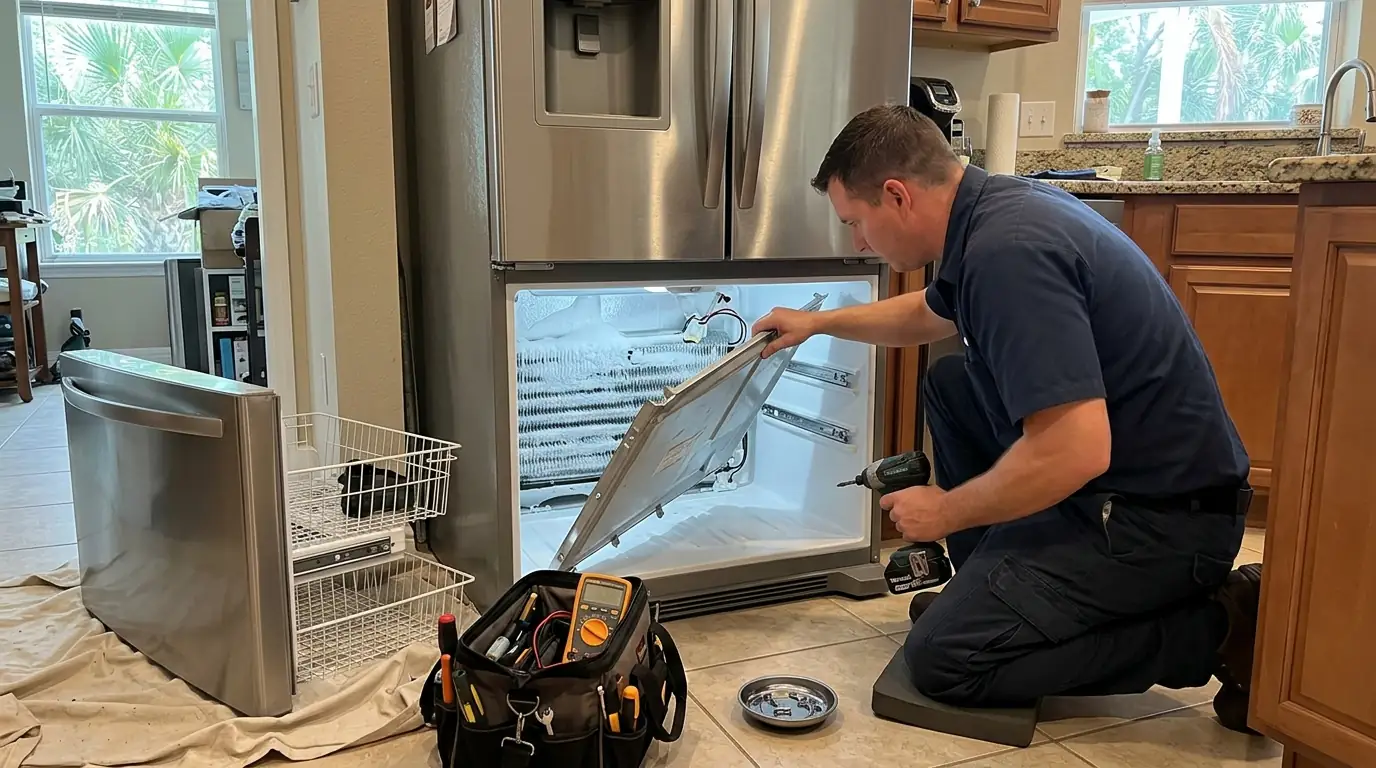
Refrigerator repair in Jacksonville usually comes down to one of four parts: a failed defrost heater, an evaporator fan, a condenser fan or a start relay. We diagnose at your home, quote the part and labor before starting, and most fixes are done the same visit when the part is on the truck.
A refrigerator moves heat out of the box with a short loop: the compressor pushes refrigerant, the condenser fan dumps heat into the kitchen, and the evaporator fan blows cold air from the freezer coil into the fresh-food side. Every few hours a defrost heater melts the frost off that coil so air can pass. When any one of those steps stops, the box warms up, and the symptom tells us which one.
A warm fresh-food side with a cold freezer points at airflow: a frosted coil or a stopped evaporator fan. Both sides warm with the compressor clicking points at the start relay or the condenser side. Water on the floor is usually a frozen or clogged defrost drain. We check those in that order, with a meter, before anyone talks about replacing the whole unit.
Warning signs
Freezer still cold, fridge climbing. Airflow from the freezer coil has stopped.
The defrost system is not clearing the coil between cycles.
The compressor is trying to start and failing, often a relay.
A frozen or clogged defrost drain is overflowing into the box.
Ice on the blades or a worn fan motor bearing.
Dirty coils or a weak condenser fan make the compressor work far longer.
Fridge warming up right now? Keep the doors closed and call. A person answers any hour.
Call (904) 907-8788The jobs this page covers
The most common call we take. We start at the bottom of the unit with the condenser coils and fan, because a matted coil or a stalled fan makes the compressor run hot and long without moving much heat. Then we pull the freezer back panel to look at the evaporator coil. A solid block of frost there means the defrost system failed, and we test the heater, the thermostat and the board that times it. A clean coil with a silent fan means a fan motor. Either way the repair is a part swap, not a new refrigerator.
Water under the crisper drawers or on the floor in front almost always comes from the defrost drain. When the drain tube freezes or clogs with debris, the water from each defrost cycle overflows into the box and runs out under the door. We clear and flush the drain, check the drain heater or the copper strap on models that use one, and make sure the drain pan underneath sits where it should. If the leak sits behind the unit instead, we look at the water line, its fittings and the inlet valve.
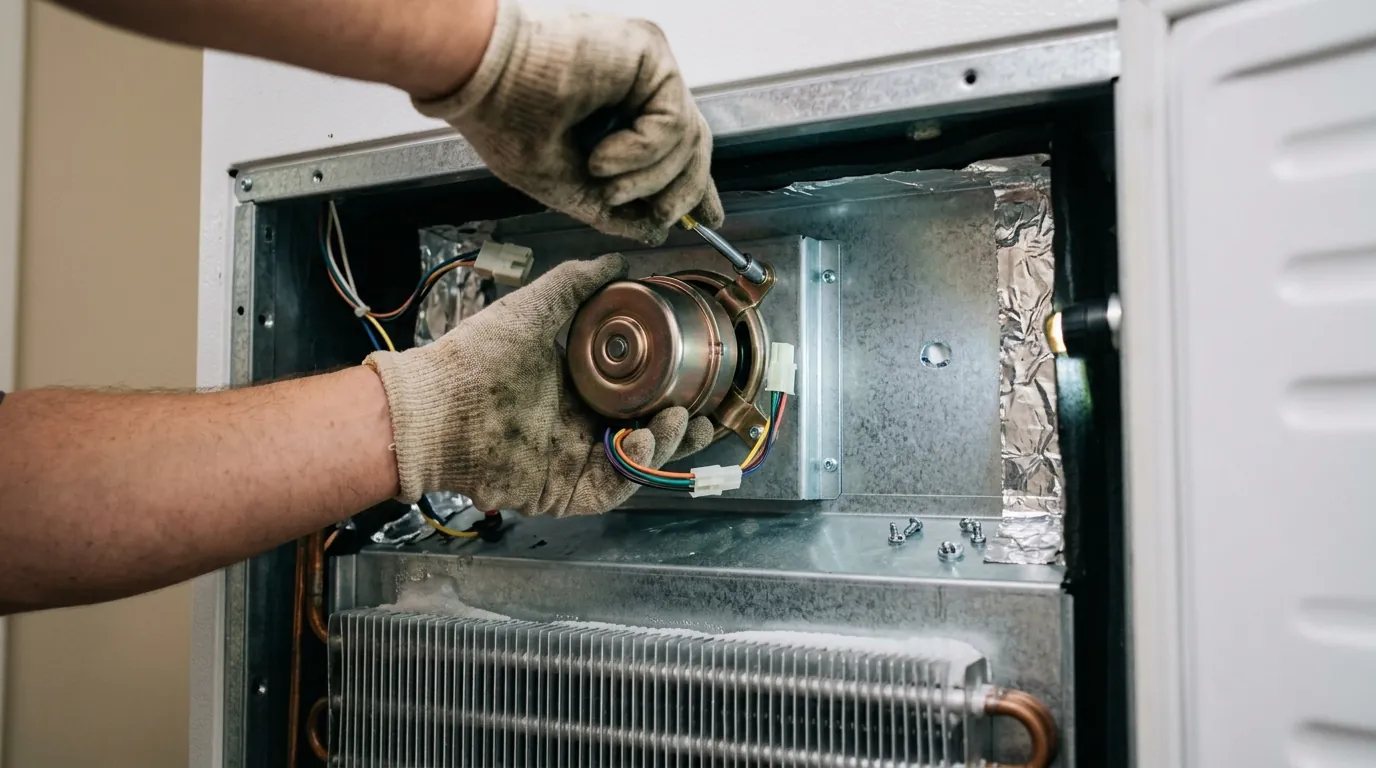
Chirping or grinding that changes or stops the moment you open the freezer door is an evaporator fan with ice on the blades or a worn bearing. A rattle from the bottom back is usually the condenser fan or a drain pan that has shifted. A loud click every few minutes with no cooling is a start relay trying and failing to start the compressor. A deep hum that never stops can be a compressor that is struggling. We listen with the panels off, find the source and replace the part that is making it.
Frost climbing the freezer back wall, ice in the air vents, cooling that comes and goes over a few days: that pattern is a defrost failure. A frost-free refrigerator heats its coil several times a day to melt the frost away. When the heater, the defrost thermostat or the control stops doing that, frost builds until air cannot pass. We test the heater for continuity, check the thermostat or sensor and confirm the control actually starts a cycle. Then we melt the coil clear so the repair can be proven before we leave.
Jacksonville runs warm for most of the year, so refrigerators here spend more hours with the compressor on than they would up north, and a second fridge in an uninsulated garage works harder still. That extra runtime is why dirty condenser coils and tired condenser fans show up on so many of our calls here. Cleaning the coils is part of every refrigerator visit, and if your unit lives in the garage we will tell you whether its rating is meant for that.
Step by step
We ask you to move perishables to a cooler before we arrive or while we set up.
Fans, relay, coils and defrost parts get checked with a meter, not by guesswork.
You approve the price, then we replace the part and melt any frost off the coil.
We watch the fans run and check the box temperature start to drop before we leave.
DIY or call
| Task | Safe to try yourself | Call a technician |
|---|---|---|
| Condenser coils dusty | Vacuum the front grille area with a brush attachment | If coils sit behind a sealed back panel |
| Door not sealing | Clean the gasket and close the door on a dollar bill to test it | If the gasket is torn or the door sags |
| Thermostat setting | Confirm it was not bumped to warm | If the setting is right and it still warms up |
| Frost and no cooling | Nothing safe beyond a temporary unplug | Always, the defrost part has failed |
Cost
Most refrigerator repairs are a single part plus labor. The range below comes from national cost data and covers the common repairs; sealed-system work such as a compressor sits above it and has its own page.
Planning range from published cost data (homeadvisor.com), not a quote and not our price. Your number depends on the diagnosis and the part.
We repair refrigerators from Whirlpool, GE, Samsung, LG, Frigidaire and KitchenAid most often, plus built-in Sub-Zero and Thermador units.
FAQ
The fresh-food side usually starts dropping within an hour and reaches normal temperature in 6 to 12 hours. A freezer takes longer. Keep the doors closed while it recovers.
If the cabinet and sealed system are sound, a fan, relay, defrost part or board repair usually costs much less than a new refrigerator. We tell you the repair price after diagnosis so you can compare.
Cold air reaches the fresh-food side through a fan and a duct from the freezer coil. Frost on that coil or a failed evaporator fan stops the airflow, which is a defrost or fan repair, not a compressor problem.
Unplugging it with the doors open for a day melts the frost and can bring cooling back for a while, but the frost returns until the failed defrost part is replaced.
Yes. We repair Samsung, LG, Whirlpool, GE, Frigidaire, KitchenAid and most other major brands, including the fan and ice compartment problems those models are known for.
Also on the list
Column, panel-ready and built-in units from Sub-Zero, Thermador, Viking and KitchenAid, serviced in place.
DetailsCompressor replacement, refrigerant leak repair and evaporator coil work, quoted against the cost of a new unit.
DetailsNo ice, slow ice, hollow cubes or a dead water dispenser. Valves, fill tubes and ice maker assemblies repaired.
DetailsChest and upright freezers that will not hold temperature, frost up or run nonstop, fixed before the food is lost.
DetailsTell us the brand and what the fresh-food and freezer sides are doing. We book the earliest window we have.
Duval Appliance serves Jacksonville and the First Coast from 6504 Leona Street in northwest Jacksonville.